Jennings restoration

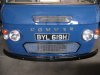
Today I restored Beryl's toothy grin.:)

2016_0501Grille0002.JPG

The aluminium surround was too far gone, so I had to rebuild sections with ally sheet and epoxy, then filler, etch primer and gloss black. held in place with stainless self tappers, because the clips were broken or missing. So all in all, quite a long job, but worth doing carefully, because the result is right in-yer-face. And looking at this picture, I see I forgot to touch up the bumper bolts, so I'm just popping out to do that...............
 
We took Beryl down to Sidmouth at the weekend. Lovely day, and free parking in East Devon District Council's "Parkland" head office car park.

Anyway, Sally drove home, and I had a chance to take in the sights, sounds and smells from the passenger seat.

There was a ticking noise coming from the engine cover area which varied with engine load, together with a slight exhausty/dieselly smell, so once back in the workshop, this had to be investigated. We can't have fumes in the cab!
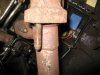
2016_0509Exhaust0004.JPG

The exhaust downpipe wasn't accurately lined up with the manifold, and soot marks were evidence of a leak. There was also a small gap between the hatch cover rubber seals, due to the edges of the steel not lining up properly. Hence the ticking noise.

The old sealing ring didn't seem to be the right sort either. The new one I got from Martin was solid steel, but the old one was sort of composite, and looked like this................
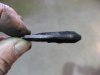
2016_0509Exhaust0012.JPG

So I slackened off all the brackets and joints in the system, and realigned the pipes, with a new joint ring to the manifold.

Should have done it right first time, shouldn't I!:oops:

Ok, no ticking noise now, but the whole area was covered in diesel AGAIN. Henc the dieselly smell.

Two more slight leaks found. One joint on a back leakage pipe and one from one of the injection pump connections. The first was easy enough, (just stole a bit of pipe off the spare truck engine), but it took a good half day to strip and seal the connection, as it was behind a load of injection pipes. I hate breaking open diesel pipe joints, as there will always be one that doesn't seal again when you put them back.:( Hardly surprising because the pressure is around 15000 PSI in there.

Anyway, hopefully they are sealed again now, and hopefully this will be the final batch of leaks to sort.

It's gradually getting drier. The drip tray doesn't have any oil in it since I did the engine, and maybe even no diesel from now on. I'm not betting on it staying dry though.

 
Been there with the 'alternative' sealing ring, it blew within 100yards of leaving home, more than just a ticking noise though:eek: Solid steel ring and a smear of goo sorted it
 
Panky: It's good to know that other people experience the same sort of problems. Sometimes I think I'm just an old fusspot. Sharing the niggles on here might well help someone else avoid them.
 
well done Colin - let's hope the database of fixes grows quickly enough for "clean fingers" Eddie in the corner here... I really need to keep learning (lots)
 
...................and while I think of it, here's the rubber seals I used around the engine hatch last year.

2016_0512Exhaust0003.JPG

That's Seals Direct ATT1976 for the hatch lid. You'll need plenty of lube (and patience!) to squeeze this in the slot.
and Seals Direct ETS60 for the metal edge around the floor. The flap pulls up to slot the carpet under.
Plenty of other suppliers available.
Then I had to put half a dozen concrete blocks on the lid for a week to squash down the seals. Quiet and airtight now though!:) A HUGE difference from before.
 
Warning. Vinyl porn coming up!

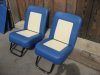
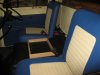
I fetched the seats back from the upholsterer today.............

2016_0602Seats0001.JPG

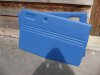
..........and the door cards...........

2016_0602Seats0002.JPG

First job was to fix a piece of polythene sheet to the door, to keep all the rainwater that drains down through the door off the back of the door cards. Sorry, no photos, but I used the row of four holes at the top to hang the sheet from. I ought to just mention that these are Dodge doors.

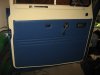
Then to fit the plastic trims. Here I came across an unexpected problem. The cards were sumptuously packed out with 6mm foam under the vinyl, and this had to be laboriously picked away at the edges of the holes to get the trims to fit. But eventually I got the passenger card fixed.

2016_0602Seats0007.JPG

C r a p photo.

Drivers card went much better.

Fitting the seats was easy.

2016_0602Seats0009.JPG

Crikey, what a difference :):D:):D:):D:):D
 
We'll need the van ready for our hols, so as we've done more than 500 miles since the engine rebuild, it was time to retorque the cylinder head and change the oil and oil filter.

The head has to be retorqued "at normal operating temperature". Sounds like a reasonable requirement until you realise what a pain in the arse the job is. I've already made a special tool to be able to use the torque wrench on the "impossible" nuts, and all the tools are laid out ready.

So I get back from a nice long run. First take off the seat belt stalk, then the bracket that holds the fuel and brake fluid reservoir and tie them to one side. Then disconnect two of the back leakage pipes and remove the lift pump to filter fuel pipe. Now I've torn my latex gloves to shreds so get a new pair. Remove the rocker cover, which won't come off directly because the floor is in the way. It has already been "modified" with a big hammer or you just couldn't remove it at all. You have to get ir just right, and its a right fiddle to manouvre it out, while it drops oil all over the clean engine. Then the rocker bar has to come off, but the floor is in the way of this too. So the two long studs that hold the rocker cover have to be removed before it can be levered off five of the remaining studs, and rotated clockwise till the bar clears the floor to pull it off the last one. Second new pair of gloves at this point. Then you can't get at three of the cylinder head nuts because the floor is in the way of that too! Twenty five minutes later I'm ready to torque the head, and the engine is quite a bit cooler than it should be.

Oh, and don't get any oil on the new cab trim!

Spitting feathers at this point !:( And none of the head nuts pulled up any further, so I needn't have bothered at all.

Anyway, all done, then a three hour wait as the tappets have to be set cold. Who designed this thing?

I guess the van was designed for the Rootes petrol engine, and the Perky was only an afterthought.

Rant ends.

The van drives so much better now the engine has been run in, and the smoke free starts are a real joy.

Ready for Northumberland and Hadrians Wall!
 
Crikey what a faff but best to be sure for peace of mind.
At last you can enjoy the fruits of your labours, notbing like sitting in a soggy field in a van you know is all your own work:)
 
I suppose the real answer to the rocker cover problem would be to fabricate a small removable panel in the floor behind the engine hatch. But do I want to be using a cutting disc inside the shiny new cab? Not just now, so it will probably wait till next time I set the tappets.
 
Back
Top