Jennings restoration

A freshly ultrasonically cleaned and reconditioned diesel injection pump is certainly a thing of beauty.........
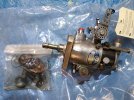
IMG_20220210_173236117.jpg

Ouch! there goes an arm. And a leg!:rolleyes:

Satisfying to see the bag of old bits they took off though. I'll fit the shiny pump tomorrow and report back. Not expecting miracles, but a bit more crispness at low revs would be nice.

In other news, all the electrical stuff has been done. By fitting a new ground lead from the rear clusters to the chassis by the fuel tank, two new wires have been freed up to the rear clusters, so I still have two spares. Reverse lights? Rear Fog lights? With the new fat ground wire and remaking and soldering all the badly made crimp connections to the rear clusters, all the lights are much brighter too. The devil is in the detail, as they say.

The 12V wiring to the fridge was much too long (why did I do it that way???) and to be honest it didn't cool much at all on the road. A little redesign has reduced the circuit voltage drop by a factor of 6 (!), so I'm hoping the beers will now be cool by the time we arrive anywhere.

The old starter motor turned out to be not so old, and perfectly OK. Brushes were nearly new. The intermittent non-operation of the starter seemed to be a Scotchlock connector "mending":D LOL a break in the trigger lead. Sorted.

The replacement fuel lift pump didn't have a hand priming handle, meaning I had to grope around where the sun don't shine to pump up fuel after a long layoff. So instead of fitting a wire handle to the pump as original equipment, which would have jingled around all the time, I had a minor brainwave, and made a removable handle to keep under the dash.

These are most of the little niggles we've discovered after using the van for six years. Hopefully it will be even more pleasant to use now.

Back on the road tomorrow............
 
Yes, re-installed the shiny pump today and put everything back on. Earth lead from the starter was fizzling and smoking so replaced it with a super heavy duty item. It's made a huge difference to cranking speed. Should have fitted a proper one years ago instead of one from my bits box!

Trial run earlier this evening.

The engine certainly feels more responsive and pulls well from idle. It's quieter but more smoky, (even after burning off the lube oil used for building the pump). It could either be that the fuelling is higher than before, or perhaps the injection needs advancing a bit. I'll have a play tomorrow. It's nearly there.

The new roller clutch release bearing is great, and getting rid of play in the linkages has made the finding gears more positive, but getting into first gear from a standstill isn't any easier. I think I'll have to dismantle the gear lever tower thingy, cos it's probably full of gunge and dead flies.

I didn't go far enough to find out if the fridge will cool my beers on the road.
 
>>>>>>>>>>OK if you've come from the "Out and About" thread, things have got curiouser and curiouser.

Beryl arrived home on the "Flatbed of Shame" today, and is now parked up in the barn with suspected cylinder head gasket failure.

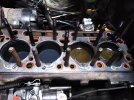
I pulled the head off straight away revealing.........
IMG_20220413_180704716.jpg

............ no less than two cylinders full of water. No wonder the engine was hydraulic locked! Mopped out the water and the bores look just fine.

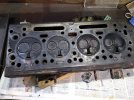
The cylinder head............
IMG_20220413_180634542.jpg
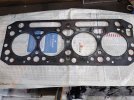
...........all looks fine, and the head gasket..........
IMG_20220413_182210134.jpg
..............looks fine too. No sign of any blow, or failure from the water jacket into the cylinders.

With two cylinders full of coolant, I'm looking for something common to cylinders 3&4 which communicates with the water jacket, and that could be the rear exhaust port. It's the only thing I can think of at the moment. So tomorrow's task will be to test the cylinder head for a crack into the exhaust port. As I said, curiouser and curiouser. More tomorrow hopefully.
 
Soooooo............
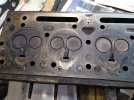
Today I crack tested the head. I blanked off the thermostat housing, and the heater connections with a loop of pipe. Then I trigged it level and upside down..................IMG_20220414_111700399.jpg

...........and filled it with water with a smidge of washing up liquid to find any cracks..........

IMG_20220414_111718795.jpg

...........but not a sign of any leakage. Dry as a chip. There is a tiny crack between the valves on 4, (left of photo) but these are very common and nothing to worry about until they've grown enough to reach the water jacket.

On cleaning the head and block, and examining them carefully, I could see the signs of a blow between 3 and 4, (left of the photo) but not enough to burn the gasket. Probably because I pulled off the A30 as soon as the heater went cold. There was also evidence of a long term weep from the coolant hole between 3&4 into the gasket area. That wouldn't have been a problem till the blow developed. So now I'm happy that the head is OK and it was just the gasket that failed. Phew! Heads are not currently available.

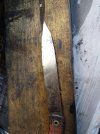
Next was to check that the piston rings (or anything else) hadn't been broken by the hydraulic locking of the engine. I had thought I'd need to drop the sump and pull the pistons, but that seemed like a lot of work (even pulling the engine? :(), so I ground the end of an old 4 thou feeler gauge to a sharp point ...........

IMG_20220414_171755318.jpg

..........and to my great relief I found I could feel the ring gap by running it around between the piston and bore..........

IMG_20220414_171913093.jpg

One gap only, and the ring is OK. Two or more gaps and the ring is broken.

To my even greater relief, the top rings on all 4 pistons were intact. The lower rings don't usually get broken in that way, so I'm happy :).

Then checked the stick-out of the pistons above the deck with a jig and feeler gauge. All OK.

Parts ordered. Everything cleaned up. Onward.
 
I mean... That whole post is like a foreign language to me, but firstly (well done) and secondly (I'm delighted for you).

Well done for a piece of incredible detective work and a fix.
 
Iam told that late timing on the injection unit can cause smoking in the Perkins . Thats what the marine people who use the Perkins tell me .
 
Iam told that late timing on the injection unit can cause smoking in the Perkins . Thats what the marine people who use the Perkins tell me .
I'm sure they're right. It's a delicate balancing act between early timing which causes detonation with that very crisp knocky/dieselly sound and late timing with more smoke. The difference is only a couple of mm at the timing marks. There is a (relatively) sweet spot but it's not that simple to find.
 
Beryl got back on the road this afternoon with the new head gasket and injection timing slightly retarded from what it was before. Must say it sounds better (not as harsh). Head retorqued too. Good to go. Just as well: We need it for next weekend. :)
 
Beryl got back on the road this afternoon with the new head gasket and injection timing slightly retarded from what it was before. Must say it sounds better (not as harsh). Head retorqued too. Good to go. Just as well: We need it for next weekend. :)
Drove Beryl up to the Forest of Dean for the long weekend to meet the families at a campsite. Quite a bit of white smoke with a stone cold engine on startup but no smoke once on the road at all . Got stuck on the M5 for 3 1/2 hours :eek: due to that horrible truck collision ( we had everyone's supper in the van too!). Two things I was glad of though. Firstly that the head gasket went when it did and not in the middle of that madness. Secondly that I had changed the clutch release bearing for the MGB roller type. There was an awful lot of crawling in and out of first gear for 20 miles!

I was a bit embarrased at starting with a bit of white smoke at the campsite, so today I advanced the injection just 1mm. Smoke practically gone now. It's amazing how sensitive it is to injection timing. The difficulties engaging first gear were down to the clamp bolt on the universal joint on the gear change mech not being tight enough. Cured that now too. There's always something to do on these vans isn't there?

We had a super weekend though:)
 
Head gasket went again.:(

Same failure as last time. Turns out the head was warped, so took it for a skim. Max 8 thou, min zero, so it really needed it. New head gasket, back on and running fine again. A right PITA though. The moral of this story is that if the head is twisted you won't find it with a straight edge, so find a flat surface. Easier said than done finding a surface that flat.

Oh well, I'll put that down to experience.:rolleyes:
 
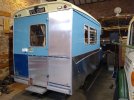
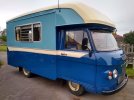
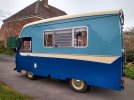
For a long time, I've wanted to replace the lower panels of the coachbuilt rear of the van.

Out of the factory, the panels were 1.2mm Aluminium, but the drivers side and half of the rear were 0.5mm (thin enough to wrap a turkey:oops:), as a result of a shunt back in the distant past. Added to that we (me actually) had made contact with a big rock sticking out of a welsh drystone wall a couple of years ago, so it was a job that needed doing.

So.....

IMG_20250118_113410718.jpg

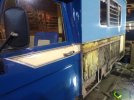
Off came the nearside panel, and......

IMG_20250126_125449962.jpg

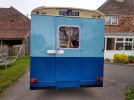
The rear panel with that dreadful toilet window had to go. Followed by.....

IMG_20250130_165639541.jpg

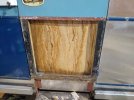
The lower half of the door which had rotted through at the bottom due to being in contact with the steel part of the frame.

IMG_20250130_165630801.jpg

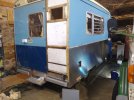
Generally the timber framework was in remarkably good nick, but I reinforced many of the joints with brackets, and renewed wood where necessary. Several hundred stainless steel screws, and a load of panel adhesive later, here's the new panels fitted......

IMG_20250202_152707803.jpg

I warmed up the barn with one of those diesel powered space heaters so that the panels were fitted warm. That should avoid the panels going slack in the summer, should the sun ever shine. The side trims took a lot of straightening, as they had been badly abused in the past. Lots of screws in those too! You should see the motley collection of screws that I took out, many of them builders drywall screws, now stainless raised countersunk slotted heads for all those in view.

I've still got the nearside panel to final fit, but it's all cut out and clamped in place, ready to do next week.
 
In other news, recently I've been having some trouble bleeding the fuel system by manually operating the priming handle on the fuel lift pump. Like the bubbles just weren't moving through the translucent pipe. The special little banjos on top of the injectors are the original ones made of cast aluminium, and over the years they had compressed, flattening the tiny holes in the sides, so preventing any fuel getting through at all. Took me hours to find the problem. I'm now making up more robust system out of standard components.
 
So now here are the photos you've all been waiting for........

IMG_20250413_161325012.jpg

Here's one of the old banjos. You can just see the hole on the far side that's been squashed flat. Not quite completely blocked, but not far to go. Of course the other disadvantage of banjos made of cheese is that the tubes break off, like the one on the right, under my finger.

And here's the re-engineered diesel leak off system......

IMG_20250413_161123011.jpg


New steel banjos, with brass tee pieces silver soldered on, and translucent tube so I can see any bubbles in the system.
 
Back
Top