Jennings restoration

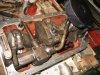
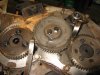
The timing idler wheel boss can float around so the backlash to the cam and injector gears has to be set with feeler gauges before the boss is tightened to the block.
2016_0109commer0013.JPG

The manual makes it look quite complicated, but once you get to do it it's straightforward enough. Each gearwheel has to have a couple of thou backlash to it's mate at any point of rotation. The crank gear had some scuffing, as evidence that this excercise hadn't been done properly last time.
Once the boss had been tightened to the block, the timing marks were checked again.............and again.
I particularly like the Perkins geared timing. No belts to snap or chains to break. Here's the timing marks lined up.

2016_0109commer0014.JPG

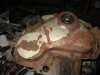
The tab washer was turned up and the cam gear bolts checked, then the temporary bolts were removed and the timing cover fitted. The oil seal is only months old so I didn't replace it.
2016_0109commer0015.JPG

Right. That's it for today. I'll finish building the engine tomorrow, hopefully. Feeling good so far!
 
Last edited:
Nah! I don't think I'll be painting the engine. It'll have a coating of diesel soon enough. Or should I be painting? Discuss please. Jim, your motor does look good though.
I read a thread on one of the boating forums which included a great long debate on how to paint the INSIDE of the engine! Not for me.

A short day's engine building today, due to doing the headlights on our neighbours tractors this morning.

Oil pump replaced.

2016_0110commer0001.JPG

The oil pipe is a right jiggle to get in the hole in the block, but done eventually. Rear seal bolted up, sump gaskets trimmed to fit the bearing caps, and sump replaced. Then the short engine was returned to its home in the van. It was much easier to do it this way as height would be very limited to get the whole engine in.

2016_0110commer0002.JPG

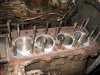
Then all the head studs were wound back in. Don't you just love those pristine bores? The oil is already grey from the rings planing off the surface of the bores. That's what running in does.

As I say, a short day, friends round for tea:) but progress just the same.
 
Those bores look amazing Colin.

Painting the inside is a little excessive for even me but love a good paint job while its out, makes me happy
 
OK.........................

I was just about to put the head back on when I reread the Perkins manual. To be quite sure.

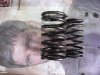
I was surprised to find that the valve springs had a top and a bottom, and had to be fitted the right way up.

2016_0112commer0003.JPG

Both the inners and outers have a close "damper" coil which has to go against the head.

[edit]Sorry about the picture of Noel Gallagher!:eek:[/edit]

Checking the head I found...................

2016_0112commer0002.JPG

You can see that the outer of No8 is OK, but that of No7 has the close coil at the top, and the iners are hidden, so they all had to come off again.:( At least it's all clean this time.

All the springs are now the right way up!

Studs replaced and gasket in place.

2016_0112commer0006.JPG

The gasket has a bead of silicone round all the relevant holes. They are supposed to be pretty good.

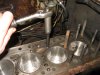
When I came to torque up the head nuts, one of them was tight on the stud. Better to sort it now rather than risk damaging a stud or a special nut.

2016_0112commer0008.JPG

I had a 7/16UNF tap, but there was no room for a tap wrench. I made a small tool to turn the bare tap, and succeeded in cleaning up the thread.

Next job was fitting the injection pump. Obviously the timing is critical, so the drive splines have a master spline on the gear wheel..............

2016_0112commer0010.JPG

..............and on the pump drive shaft.

2016_0112commer0011.JPG

Just line them up and pop the pump in. Easier said than done because the bottom nut for the pump is a right swine to get in.

2016_0112commer0012.JPG

Not a very clear picture, 'cos it's down where the sun don't shine! There is a casting rib in the way, so you have to move the pump to the right to get the nut on the stud, then the shakeproof washer falls off, which is what has happened here.:rolleyes:

2016_0112commer0013.JPG

That's the pump finally installed. The mounting holes in the flange are slotted, and the pump must be rotated so that the timing marks on the engine and pump casing are exactly lined up. You can see the mark on the engine casting, but the one on the pump flange isn't clear. If this is not spot on, the engine will run like a pig.

Next the fuel filter could be refitted and piped up.

2016_0112commer0020.JPG

Together with the radiator, fan, alternator etc.

2016_0112commer0021.JPG

The alternator isn't actually a good fit. The setup was originally designed for the crappy old 10AC alternator. That's why there's always spare wires sculling around in the loom between here and the fusebox area. So it's all abit agricultural really, and that adjusting strap isn't too clever! I tried to come up with some kind of improvement, but failed, and left it as it is. It works.

Continuing in another post...............
 
Last edited:
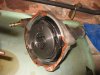
The rest of today was taken up with various vibration problems. Diesels are notorious for hard vibrations damaging anything touching them.

When I went to put the throttle linkage back on i found it badly worn where it goes through the pump arm.

2016_0112commer0016.JPG

That introduced a lot of slop in the system, so built up with the welder, then filed back round (ish).

2016_0112commer0018.JPG

Then reassembled with a spring on one side, and a fibre washer on the outher to reduce vibrations, and hopefully wear.

2016_0112commer0019.JPG

The next vibration problem was the dip stick outer pipe. I had previously mended it and damped it's vibrations by zip tying it to the breather pipe as a temporary measure. This time I made up a bracket from a manifold bolt as a permanent solution.

2016_0112commer0022.JPG


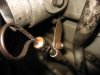
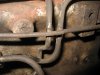
I had also noticed some wear on the injection pipes to 3 and 4, but couldn't work out how it had happened, that is until I fitted the stop cable.................

2016_0112commer0024.JPG

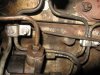
Then it became obvious. The stop cable had been rubbing gently against the pipes for years. Also obvious was that the parallel pipes at this position were designed to be fitted with injection pipe clips, which must have been left off at some time. The particular kind of vibrations that affect injection pipes tend to work harden. Then crack. Then spray a fine mist of high pressure diesel over a nice hot exhaust manifold. The clips are absolutely essential, and designed to spoil the vibrations by joining two pipes together, (each of which has a different natural frequency), so that neither can vibrate.

I found some clips on a spare VW engine and fitted them on these parallel pipes.

2016_0112commer0025.JPG

Now the stop cable can't wear away at the pipes. It will have to get through the clip first;). And the pipes won't vibrate, crack, and set the van on fire. Hopefully.

I think I may have mentioned before that you have to be pedantic when dealing with diesels.
 
Yes, fiddly, but as with many things, the devil is in the detail.

Time to put the transmission back on. There was nothing particularly noteworthy about replacing the adaptor plate, flywheel, and clutch, apart from using heavy grade loctite on the flywheel bolts.

I had two annoying slight oil leaks, one from the gearbox selector cover, and one from between the brake ring and the rear casting of the overdrive.

First job was to release the torque lock between the input and output shafts so they could be separated. This is equal to the torque that was applied to the unit at the instant it was last disengaged. It is usually strong enough to prevent the two halves being separated.

2016_0113commer0001.JPG

Here I've removed the plug by the solenoid, and screwed a grease nipple into the hole. Then connected 12v to the solenoid and pumped oil from a greasegun into the nipple. A slight plop indicates that the internal brake ring has been disengaged and the torque lock released. So far so good.

Next the rear casing nuts were removed, and theoretically, a light tap would separate the casings.

2016_0113commer0002.JPG

But when tapped, there was one stud which just wouldn't release. I was afraid to tap too hard, for fear of breaking the rear casting, or even pulling the rather delicate studs out of the front casting. I'd rather lose the stud than either of those options.

I tried locked nuts, then welding a nut onto the stud, but just ended up breaking off the stud close to the casting.:eek:

2016_0113commer0003.JPG

You can see that it is well corroded in the hole. That is the stud that carried the ground connection for the solenoid, which had caused the corrosion.

So I stood the transmission on the bellhousing and drilled out the stud.

2016_0113commer0004.JPG

I've been caught out in the past trying to drill out studs, starting with a small pilot hole, and snapping the drill bit in the stud.:oops: Now I use a drill bit slightly larger than the stud, check and correct for concentricity every few seconds. This worked a treat, and I could remove the casing at last. Phew!

2016_0113commer0005.JPG

Here's the planet gears inside the rear casing.

2016_0113commer0006.JPG


2016_0113commer0006.JPG

The planet gears can stay where they are in the rear casing.

The cast iron brake ring won't come off until some more stuff in the middle casing has been removed.

2016_0113commer0007.JPG
The middle casting was removed next.

2016_0113commer0008.JPG

Removing the four nuts and the straight bridge pieces releases the thrust bearing and all the innards from the middle casing, and you're left with this.

2016_0113commer0009.JPG

Now the stud could be removed. I found a suitable 5/16 UNF item in my "scraps that might come in useful under some unknown future circumstances" tin and made a stud to match the damaged one.

2016_0113commer0010.JPG

Assembly, as they say is basically the reverse of dismantling. No pictures here, because I forgot to take any.:oops:

Continuing on another post...........................
 
Last edited:
One very important point though is that when refitting the assembled overdrive onto the gearbox output shaft, the shaft has to slide into two splined sections, one after the other, and if these two splines aren't lined up, the shaft will only go into the first, and the overdrive will end up stuck about half an inch from where it should be. The trick is to line up the two splined sections with a long thin screwdriver, then the unit slides straight on. In theory at least.

The other oil leak was from the gearbox selector cover.

2016_0113commer0011.JPG

This was a simple case of taking it off, cleaning up and resealing. The old gaskets were generally knackered, so were scraped off, and I used instant gasket instead.

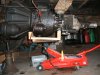
So the gearbox and propshaft etc were replaced on the van. The trolley jack with the gearbox cradle sure does make it easy! (See the first picture in this thread)

With a bit of luck the engine should be ready to run tomorrow.

Meanwhile after putting everything back together, I have one small piece left over.

2016_0113commer0012.JPG

It's obviously a bracket of some description, but I haven't a clue what it is. Any ideas anyone? It may be diesel specific, so I won't hold my breath for answers!!

I'm very excited about tomorrow.:D
 

Attachments

  • 2014_1211Commer0009.JPG
    2014_1211Commer0009.JPG
    106.4 KB · Views: 7
Come on Colin it's obviously part of the planet gear assembly;)
Great description and pics as usual, looking forward to the big turn over myself:)
 
Come on Colin it's obviously part of the planet gear assembly

Better not be! Actually, I've found out where it comes from. It was attached to the inlet manifold. Now I know where it goes, I still don't have a clue what it is supposed to hold there. There's nothing in the vicinity that needs any kind of support.

So today I replaced the fuel lines, pump, injectors, oil filter, exhaust etc. etc. and filled up with fluids.

Bled the fuel system through, but no start:(. There's a substantial air leak on the suction side of the fuel system again, and I'm not going to get it started until I get that sorted. I've had enough of these leaky joints, so I will take the pipes and the hard olives off, put a small flare on the pipes, then use rubber seals in place of the olives. They do seem to be better in worn joints than the brass olives. But I do have some serious compression now, which makes the starter grunt in a suitably dieselish manner. Oh well, another day passes................................................................
 
So today, there were three problems to solve. (At least on the van. Plenty of problems elsewhere!)

1. The oil pump wasn't priming, even though, (or perhaps because) I had pre-filled the oil filter before screwing it on. I like to get some oil pressure up before I go for a start, but this one wasn't playing. I hate dry starting an engine! The more cranking I did, I could imagine the big ends drying out. I decided to take the oil filter bracket off, and squirt some oil back down the oilway, and hopefully seal the pump so it would pull oil. I took out the injectors so the starter and battery would have a much easier job to do. Just a few seconds cranking and I had oil pressure (50PSI at cranking speed!). Note to self...........Next time pre-prime the oil pump as well. Problem no.1 solved.

2. The air leak on the suction side of the fuel lift pump. Many of the pipework joints are into old aluminium castings which have got badly worn over the years, and just won't seal metal to metal any more. I cut off the old brass olive, put a tiny flare on the pipe (just waggled a bit of steel in the end of the pipe) and used a hard rubber olive. Instant cure to problem no. 2.

3. The non starting problem. Bled the system again. No start:(. Bled the system again. No start:(. Perhaps the timing was out. Reread the Perkins manual to see if I'd missed anything. Printed out my photo of when I set up the timing marks, just to be sure. I would have to take the cover off the injection pump to check the internal timing mark, but couldn't see any way the timing could be out. The manual even says there's no way it can be wrong. One more try first now the battery had a bit more charge. Engine started and ran. There was a mushroom cloud of smoke from all the unburnt oil and diesel sculling around in the cylinders, and a bit of a blow from a badly seated injector, but after half a minute it settled down to a steady beat, and soon a perfect idle. Sounds luuuuuuuurvely:D. When warmed up a bit, it had a nice diesely burble, and lots of oil pressure.

Floor hatches back in, seats refixed, engine cover on. Ready for a short drive and head retorque tomorrow. (But that involves cracking open the diesel lines again:eek:)
YAY!:D
 
RESULT:D
Just a bit of fettling to do and job done. Say it quickly and it doesn't sound much;)
 
View attachment 732

It's obviously a bracket of some description, but I haven't a clue what it is. Any ideas anyone? It may be diesel specific, so I won't hold my breath for answers!!

I'm very excited about tomorrow.:D[/QUOTE]

Could be a lifting eye or maybe some sort of support for the air cleaner?
 
Could be a lifting eye?

Nope, got rid of that, it was in the way of taking the head off.


or maybe some sort of support for the air cleaner?

Nope, that's under the drivers seat, fully supported!

But thanks for the suggestions.

Cor! What a PITA torquing down the head! I'd already modified the rocker cover with a big hammer so I could get it on and off with the engine in. Today I found that the rockers won't come off without pulling the long studs, and removing sundry diesel pipes. Then there's precious little room under the rear of the hatch to torque up the back head studs. Grrrrrrr!

Anyway, all done, and we went for a 50 mile drive this afternoon. It's great!

Needless to say there is still a little niggle to sort out. The injectors need checking. Now the engine itself doesn't smoke, on starting, even after a short break, there is a big puff of pale smoke. I think the injectors are dribbling. That's one of the few jobs I don't do myself, so I'll be getting a specialist to do them.

Onwards.............
 
...............the joys of owning a perfect purring Perky:)

Funny you should say that. I've been driving exclusively oil burners now for 20 years, so when I get to drive a petrol vehicle, I'm always afraid they are going to break, they won't pull away without stalling, and that steady beat is missing. I know it's just a state of mind, and I'd have to drive petrol if I lived in town (or take the bus).

I've just pulled the injectors, and they don't appear to be leaking into the pre-combustion chambers, so the white smoke on startup must be just bad atomisation I think. Off to the specialist tomorrow for a verdict.
 
Back
Top