Jennings restoration

Colin

This looks really interesting... My wiring (as proved in the flesh over the weekend) is shot and needs replacing - you're re-wiring the harness rather than buying a new one - would you know which one to buy if you had to? Or is it just as simple to get done from a diagram...

This is an auto electrician job for someone other than me, so I'm expecting that actually cutting off and starting again is likely to be quicker (and cheaper) that tracing a fault.

I blew several fuses yesterday trying to get home, so it's not a situation I'm prepared to leave unresolved (spending my Christmas savings already!)

Edward
 
OTRA:

I think the congrats may be for getting home without the dreaded tow truck.

As far as I know new wiring harnesses aren't available. If you (or an auto electrician) could just strip the old wrapping off the old harness, and use a load of tie wraps to hold it all together, then you will be able to see any damaged wiring. You can then replace it wire for wire, one at a time, but keeping the harness together. Pull the new wire in before you pull the old one out! Count the number of strands in the wires you want to replace, and order wires with the same colours and number of strands. The strands are all 0.3mm dia AFAIK. So far not a lot of electrical knowhow is required, and the wiring diagram isn't really needed. Then you will need to put connectors on each end of the wires, and this is where skill is required. Because I don't like to rely on amateur crimped connections for the long term, I always crimp them with a cheap tool, then run a little solder into the crimped joint. The crimp will prevent the wire falling out, and the solder will make a really good connection. Every connector shoud have a proper plastic shroud too. That is generally where short circuits seem to occur.
You can add any other wires you need at the same time, then wrap the whole lot in harness tape. Don't use ordinary self adhesive electricians tape, cos it's not fuel or oil proof, and the glue will get all slimy and the tape will slide around and unpeel itself, and look very messy after a couple of years. The original harness tape didn't have any adhesive. It was applied with a slight stretch and 2/3rds overlap, and the ends were just tucked in and secured with a spot of what looks like superglue.

In my van someone had done something to the ignition switch without disconnecting the battery, and those unshrouded connectors had shorted to the chassis and burnt out the big fat brown (unfused) wires. I took the oportunity to include master fuses to the light switch and ignition switch, which involved adding some extra fat wires. Just my luck that on the way home from Commerfest, the lights all failed. The brand new master fuse to the light switch had been badly made, so while it looked fine and had worked OK, it wasn't making any connection............took me a while to find!
 
I think it's about time for another update.

The van went well all last summer, but there were oil leaks from the engine, and oil drops blown out of the breather which indicated rather too much blow past the piston rings. The engine also felt like a petrol engine when turned over by hand, so there was obviously a compression problem which needed investigation.

First option was a job I've done many times, which was new rings and bearing shells to extend the engine's life. This can be done without pulling the engine. Then once I had got the head off, I could check the bores, and take it from there.

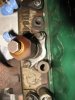
There is a lifting eye bolted on the back face of the cylinder head, which would prevent the head coming off, so first job was to remove it. You can just see it top right of this photo.
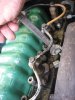
2015_0614Commer0017.JPG

It's right against the bulkhead, so I bent an old open ended spanner into a right angle so I could get at the bolts. Then released the gearbox mounts and jacked the engine forward half an inch to get clearance to remove them.

Then, confident that I could get the head off, the gearbox, was removed (Again!), so I could do the rear crankshaft bearing. This meant that a temporary support would be needed at the back of the engine, so I used a timber batten across the back off the engine hatch, out of the way, and a steel strap to a bolt hole at the back of the engine.
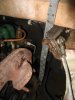
2015_1216CommerEngine0005.JPG

Then I could remove the jack from under the engine and remove the sump.

But it's never that easy........................

The steering arm was in the way, so it had to go.

2015_1216CommerEngine0004.JPG

It's really tight to get a socket to the top bolts, and no access for a spanner, so the engine was jacked up about half an inch. until I could get a socket in there. Once unbolted, and the ball joints popped, the steering arm could (just) be jiggled out, and the sump was easily removed.

The sump was nice and clean inside. Well anyway, as clean as an old diesel sump can be. No sludge, swarf, lumps of metal, or other nasties to be seen.

Next job was to remove all the bits and pieces from the engine to free up the head.

2015_1216CommerEngine0006.JPG

It's surprising how much room there is once the various bits come off. Plastic bags over the diesel pipes to keep dirt out.

The engine had to be lowered again to get the rocker cover off, and once the rocker assembly had been unbolted (DON'T FORGET THE OIL FEED PIPE DOH!) the head could be unbolted. The head didn't want to budge though, bashing it with a block of wood from underneath didn't have any effect, so I welded up a puller which bolted into holes in the side of the casting, and pushed down on one of the head studs.
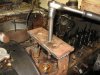
2015_1216CommerEngine0007.JPG

Now that's a real beast of a tool, using the fine thread and nut from a set of gear pullers, and some scrap steel. Needless to say, it did indeed pull the head off!

With the head off, the cause of the sticking was easily seen.

2015_1216CommerEngine0008.JPG

The second stud from the front at this side was rusted in its hole. This was caused by the long head nuts which can pool condensation, giving it all the time in the world to run down the threads into the hole.

The studs were removed with a slilson wrench (the threads weren't long enough to use two locked nuts), and that rusty stud needed some serious effort. I had to use a BIGGER stilson, then an EVEN BIGGER stilson, plus lumps of wood to stop the engine rotating on its mounts.

Now it was obvious that the bore wear was too great for plan A. New rings would bash against the wear ridge until they broke. I'm a bit surprised about this wear in a relatively low mileage engine.

Plan B was immediately put into action. New liners. It's a pity they aren't "lift out" wet liners like the 4203s, so the block would have to go to the local engine reconditioners to have the old liners pressed out, new ones pressed in, bored and honed.

Oh well. this van was always going to be a project.

Now the short engine is ready to lift out.

2015_1216CommerEngine0009.JPG

That top bolt near the engine for the injection pump is a real swine to get at. That must be why it wasn't done up properly. I cut up a 5/32 allen key, and used it in a 5/32 socket with a long thin extension.

I've made up and fitted a lifting eye, so just the engine mounts to release, and it should lift out. I've ordered an engine crane, which should be here tomorrow. Can't think why I never had one before.

I've also ordered a Perkins 4108 rebuild kit from parts4engines.com. As I already had a set of genuine Perkins rings, they agreed to knock the price of the rings off the kit. Very helpful.

This is starting to get expensive!:eek:

[edit]Edited for spelling[/edit]
 
Last edited:
It's never simple is it:( Great way to keep warm on a winters day though:D
I did the crank and piston rings on Harvey's engine a couple of years ago with the block in situ, in retrospect if I'd have had enough room to take the engine out instead I think I would have - not much else to take off.
Brilliant idea with the head jacking tool
 
Good news...........The shiny new engine crane turned up.
Bad news..........the arm wasn't long enough to reach the centre line of the van through the open door.
Solution..........quick calculation showed I only had about 150kg to lift so I extended the arm a bit!

So here is the engine out.

IMG_0961.JPG

That adjustable lifting bracket was really useful to get the balance right.

Stripping an old diesel is always a filthy business.

IMG_0962.JPG

Once dismantled, it was outside for jet washing. Then kerosene and a brush. Then jet washing again. Then dry off and oil the bearing surfaces.

It all looks a lot better when cleaned up.

IMG_0966.JPG

Except for....................

IMG_0963.JPG

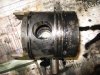
So that explains low compression on no3! With a big chunk of top ring missing (anyone know how the broken bit gets out?) and no 2 ring stuck, it's a wonder that one fired at all.

Still waiting for my engine rebuild kit, and "relining man" says it won't now get done before the holiday.

So I'll just have to concentrate on beer and mince pies.
 
great work Colin...mines coming out in January to get a rebore with +0.40 I got from Cyprus. Was going to try ringing it but the pistons were so cheap I thought may as well go the whole hog if I can take the short block to the engineers myself, bore and hone won't cost much and give me piece of mind. Going to get the 'Tim Treatment' on the head at the same time to raise power, also electric fan to cut the noise in the cab - sure most of it is from the mechanical fan, then just the gearbox seals to replace and a new higher diff I've got and it'll be back on the road in time for Summer 2017 ;)
 
Hi Jim

I did think about gas flowing the inlet ports. Now that I have the extra time I might give it a go. It won't give any more power, but more air in = less smoke out.

Good luck with the work.
 
Yes - should get more power on the petrol, it's a standard tuning thing on the alloy 1725cc head, there's a book on it somewhere apparently with templates to use for best effect.
 
Harvey's original engine had a similar issue with No1 piston only a chunk of the edge of the piston crown was missing too:eek: The pitting on the piston crown suggested that the bits had been mashed up and spat out of the exhaust valve
 
Panky..........Looking at that piston again, I think the missing bit of ring was still in place when I pushed the piston out. Must have got lost in the dirty newspaper.

Spent a couple of happy hours gas flowing the ports. One of the inlets had a very large casting ridge right in the throat, and they all had rough edges. So nothing drastic, I just radiused out all the edges and took off the worst of the roughness. I doubt if it will make a load of difference, but it will be as good as it can be.

Oh, and the engine parts turned up late this afternoon, just too late to get them to "relining man". Oh well, there's always another week.................in January!

I'll rebuild the head tomorrow.
 
Probably best to do some work on the exhaust ports too, the flow has to get out as well;)
 
Probably best to do some work on the exhaust ports too, the flow has to get out as well;)

Yes that's true to an extent, but being a diesel with ~20:1 compression, no valve opening overlap, ~20 bar pushing it out and only ~1 bar pushing it in, compared with doing the inlets, the exhausts aren't going to have much effect at all.

I did take the edges off the exhaust ports though. Just for completeness.

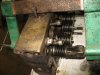
Anyway, I got the valve gear all cleaned up and assembled the head. Here's the last collets going in.

2015_1219Oakbend0008.JPG

Oops, forgot the core plugs.

2015_1219Oakbend0009.JPG

So they had to come out, and I made up some hardwood drifts to knock the new ones in.

2015_1219Oakbend0011.JPG

They are seriously thick core plugs, and veeeeeery tight to knock in!

Here's the head all ready for the rocker shaft to go on.

2015_1219Oakbend0013.JPG

Having the manifolds on will make the head much easier to lift back on.

The injectors are not tightened up yet because............

2015_1219Oakbend0014.JPG

One of the holding flanges is cracked. Damn. I really didn't need this. Why on earth would they make these of cast iron? I think tomorrow will be taken up with making one of these out of 10mm steel. In fact I think I'll make two for good measure, and see if I can improve the strength a bit.
 
Panky..........the valve compressor was the only one I could find that would do Volvo cam-in-head valves back in 1985.

Today's job was to make a couple of the plates that hold the injectors in.

2015_1220commer0001.JPG

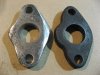
There's one of them, compared with the original cracked cast plate.

And here's the other one fitted.

2015_1220commer0002.JPG

You can see that the shape has to clear the long cylinder head nut.

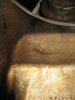
Some of you may remember the damage to the cast aluminium sump caused by the poor overdrive mount, which let the engine slop back and forth under braking.

From the outside.............

2015_1220commer0004.JPG

Now with the sump off and all cleaned up, I had an opportunity to closely examine the inside.

2015_1220commer0003.JPG

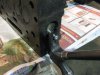
That could be one of those annoying oil leaks. I think this is case for an epoxy-glass repair.

The fun just keeps on coming!:rolleyes:

And just why does my camera keep rotating pictures when I haven't asked it to?
 
That rotating of pics seems to happen a lot if you use a phone camera as opposed to a 'proper' one. iPhones seem to be the worst culprit from what I've seen.
 
Engine came back from 'relining man' yesterday.

First it got a good scrub with detergent and water to remove any machining debris that might be hanging around.

2016_0109commer0001.JPG

Then a hose off and dried with a fan heater. All proper shiny now.

Once the new pistons were heated up with a hot air gun the gudgeon pins could be pushed out and attached to the old con rods.

2016_0109commer0002.JPG

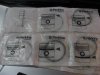
The genuine Perkins rings come in a posh packaging which leaves no doubt how they should be fitted.

2016_0109commer0005.JPG

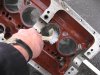
Next the bores were measured and the ring gaps were checked in the bores. I've never ever had a problem here, but it's better to find out now than too late! Rings are pushed down the bores using an upside down piston.

2016_0109commer0003.JPG

That's a long boring job, but at last the rings were fitted using a couple of feeler gauges as I don't have a fancy fitting tool.

2016_0109commer0004.JPG

Once I've fitted the oil rings from the bottom, I like to pop the pistons in the bores, resting on the bottom ring to fit the other rings. Stops them rolling around.

2016_0109commer0007.JPG

As I don't have a fancy ring compressor either, I just bent up a strip of aluminium, and compressed with a mole wrench. Works fine. Just oil liberally, and tap the piston through GENTLY with a wooden hammer handle.

Once the pistons were in the block was turned over, and the main bearings laid in. I'm using green assembly compound, and it does seem to be exceedingly slippery and tacky stuff.
2016_0109commer0008.JPG


The crank was laid in and the main bearings and big end caps bolted up. More assembly compound.

2016_0109commer0009.JPG

The crank was turned with a bar while tightening the caps to check for tight spots. Once declared OK the caps were torqued up. Then the crank was rotated 50 revolutions to loosen up the bores. It gets a lot smoother quite quickly.

Then the cam followers were replaced, and the cam lubed up and slid in.

2016_0109commer0010.JPG

Thrust plates were located before the end plate which holds them in place was fitted.

2016_0109commer0012.JPG

I used temporary bolts in some of the holes to hold the plate against the gasket until the timing cover can be fitted later.

I've had my full complement of pictures here, so will continue in a new post........................
 
Back
Top