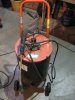
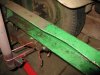
The Karrier is using a litre of oil with every tankful of diesel.........................time to have a look at the engine I think.
First though, the cab mats were a disgrace, so I bought some chequer plate style rubber matting and made some nice new mats while the seats were out.

Might even get the drivers seat reupholstered while I'm at it.
This could even turn into a bit of a makeover. Hmmmm.
The Karrier was cunningly designed with a cab floor that completely dismantles so the engine could be fully reconditioned while still in place. Just as well, as getting it out is going to be, shall we say, interesting.
The grille comes off easily enough, except that two of the fixings are behind the cab heater and the electrics panel.
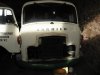
After a stormy night, the sun came beating through the windows, upsetting the camera.
Out with the radiator.

If only it was this easy to get at the fan belt with the radiator in place. Anything to do with the alternator normally has to be done lying underneath with the blood draining out of your arms.
Then all the peripheral bits came off.

The engine is a bit tall to get out from underneath without jacking the truck up a long way, so it's easier to remove the head in situ, and also make the engine lighter. It is a big old lump.
So, "orf with his head".
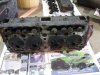
I like the idea of having the cam followers in the head. They are all in good nick and showing no wear or pitting, as is the cam which is right at the top of the block.
Next job was to pull all the head studs.

Locking nuts are all very well, but most of the studs still needed more effort from a big pair of Stillsons. Yes I know, stillsons damage the studs, but so does doing locking nuts up too tight and stretching the threads, so the lesser of the two evils is a few teethmarks on the studs.
You can see increasing amounts of oiliness in the bores from left to right in the next photo.
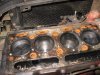
So it is fairly obvious where my oil consumption problem was coming from.
Then in with the crane.
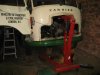
The idea was simple. Unbolt the mounts and bellhousing, pull the engine forward as far as it would go, then lower it gently to the floor.............................if only it was that easy. I misjudged the thickness of the flywheel and clutch together, (it's about 6 inches!) so with the engine smack against the front crossmember, it was still about half an inch too tight to drop the engine. With the engine hanging on the crane, and the gearbox input shaft entangled with the clutch, I couldn't go back, so in the end I settled for removing the clutch cover working through the gap, then tying it up inside the bellhousing so I could drop the engine. Not fun at all!
I can't put it back using that method, so the gearbox will have to be moved back a couple of inches to make room.
So finally, the lump was out on a piece of ply on pipe rollers, and easy to roll out from underneath the truck.
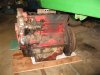
The lifting bar is the kind I make for most of my engine lifts. It bolts into two head stud holes, and has several holes for the shackle so I can get the "angle of the dangle" of the engine just right. Very important for lining it up easily. That engine's built like a brick privy for a lifetime's service. At 55bhp, it's the same(ish) power output as the 4108 in the camper, but with nearly twice the cubic capacity and governed at 2600RPM, it has masses of grunt.
In the next exciting episode, we should get to see inside, and find out why there's all that oil in the bores.
First though, the cab mats were a disgrace, so I bought some chequer plate style rubber matting and made some nice new mats while the seats were out.
Might even get the drivers seat reupholstered while I'm at it.
This could even turn into a bit of a makeover. Hmmmm.
The Karrier was cunningly designed with a cab floor that completely dismantles so the engine could be fully reconditioned while still in place. Just as well, as getting it out is going to be, shall we say, interesting.
The grille comes off easily enough, except that two of the fixings are behind the cab heater and the electrics panel.
After a stormy night, the sun came beating through the windows, upsetting the camera.
Out with the radiator.
If only it was this easy to get at the fan belt with the radiator in place. Anything to do with the alternator normally has to be done lying underneath with the blood draining out of your arms.
Then all the peripheral bits came off.
The engine is a bit tall to get out from underneath without jacking the truck up a long way, so it's easier to remove the head in situ, and also make the engine lighter. It is a big old lump.
So, "orf with his head".
I like the idea of having the cam followers in the head. They are all in good nick and showing no wear or pitting, as is the cam which is right at the top of the block.
Next job was to pull all the head studs.
Locking nuts are all very well, but most of the studs still needed more effort from a big pair of Stillsons. Yes I know, stillsons damage the studs, but so does doing locking nuts up too tight and stretching the threads, so the lesser of the two evils is a few teethmarks on the studs.
You can see increasing amounts of oiliness in the bores from left to right in the next photo.
So it is fairly obvious where my oil consumption problem was coming from.
Then in with the crane.
The idea was simple. Unbolt the mounts and bellhousing, pull the engine forward as far as it would go, then lower it gently to the floor.............................if only it was that easy. I misjudged the thickness of the flywheel and clutch together, (it's about 6 inches!) so with the engine smack against the front crossmember, it was still about half an inch too tight to drop the engine. With the engine hanging on the crane, and the gearbox input shaft entangled with the clutch, I couldn't go back, so in the end I settled for removing the clutch cover working through the gap, then tying it up inside the bellhousing so I could drop the engine. Not fun at all!
I can't put it back using that method, so the gearbox will have to be moved back a couple of inches to make room.
So finally, the lump was out on a piece of ply on pipe rollers, and easy to roll out from underneath the truck.
The lifting bar is the kind I make for most of my engine lifts. It bolts into two head stud holes, and has several holes for the shackle so I can get the "angle of the dangle" of the engine just right. Very important for lining it up easily. That engine's built like a brick privy for a lifetime's service. At 55bhp, it's the same(ish) power output as the 4108 in the camper, but with nearly twice the cubic capacity and governed at 2600RPM, it has masses of grunt.
In the next exciting episode, we should get to see inside, and find out why there's all that oil in the bores.