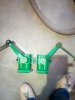
The Armstrong lever shock absorbers on my Karrier Bantam truck have been leaking tiny amounts of oil around the spindles for years. I have been moving building materials with it, and the leaks had got to the point where I felt I had to do something. The units were fine apart from the leak, with no apparent wear, so it wasn't necessary to completely dismantle them, just pull the arms off.
There isn't much information on these shockers on the web, but I thought I'd have a go at changing the oil seals anyway. The units are very similar to the rear shockers on our vans, only larger, so the process would be very similar. The good news is that it's feasible to DIY. The bad news is it's easy to break them.

The arm is a heavy interference fit on the spindle, and has flats on the rear of the boss obviously made for pulling it off, so I made a real BEAST of a puller

That's a seriously strong 18mm fine thread bolt and two high tensile nuts in a piece of 50x6 steel bent to shape and with lugs welded on to engage with the flats on the shock absorber arm. The C shaped piece of 12mm thick red steel is to stop the puller legs spreading under load.

Here it is in place. Arm held in the vice. and index marks punched into the arm and spindle to replace it on the correct spline. I used a 3/4 drive socket with a 3 foot long tube, and although I thought the puller was going to break, the arm came off OK.

Next the unit was held in the vice, and a hose clip was tightened around the casting, cos it would be easy to break when replacing the seal. I pulled out what I thought was the seal, using a self tapper, but it turned out to be just a dirt shield, and the oil seal was just a rubber ring inside.

The rubber seal can be picked out with a small screwdriver.

.............and a new standard oil seal driven in with a suitable socket or piece of tube. Here's the new seal in place.

The casting has chipped away where it had been peened over the old dirt ring, but due to the hose clip no serious damage done.
To press the arm back on, we need access to the other end of the spindle, because if we press on the casing it will just break. So next job is to weld a nut onto the dished washer and pull it out using threaded rod and a piece of tube.

With the end of the spindle exposed, the arm can be pressed back on. I used the vice like this........... he s
he s
............using a nut to transfer the force to the back end of the spindle (NOT THE CASING). After about 6mm it got too much for the vice, so I took to tapping the boss with a hammer and steel drift like this............

...........only I couldn't show the drift cos I only have two hands. The steel ring is so that the spindle can be pressed right through the arm by a couple of mm. Anyway, by pressing with the vice and tapping at the flange at the same time, the arm slowly got pressed in place.
I've had my 10 pictures, so I'll continue in another post.
There isn't much information on these shockers on the web, but I thought I'd have a go at changing the oil seals anyway. The units are very similar to the rear shockers on our vans, only larger, so the process would be very similar. The good news is that it's feasible to DIY. The bad news is it's easy to break them.
The arm is a heavy interference fit on the spindle, and has flats on the rear of the boss obviously made for pulling it off, so I made a real BEAST of a puller
That's a seriously strong 18mm fine thread bolt and two high tensile nuts in a piece of 50x6 steel bent to shape and with lugs welded on to engage with the flats on the shock absorber arm. The C shaped piece of 12mm thick red steel is to stop the puller legs spreading under load.
Here it is in place. Arm held in the vice. and index marks punched into the arm and spindle to replace it on the correct spline. I used a 3/4 drive socket with a 3 foot long tube, and although I thought the puller was going to break, the arm came off OK.
Next the unit was held in the vice, and a hose clip was tightened around the casting, cos it would be easy to break when replacing the seal. I pulled out what I thought was the seal, using a self tapper, but it turned out to be just a dirt shield, and the oil seal was just a rubber ring inside.
The rubber seal can be picked out with a small screwdriver.
.............and a new standard oil seal driven in with a suitable socket or piece of tube. Here's the new seal in place.
The casting has chipped away where it had been peened over the old dirt ring, but due to the hose clip no serious damage done.
To press the arm back on, we need access to the other end of the spindle, because if we press on the casing it will just break. So next job is to weld a nut onto the dished washer and pull it out using threaded rod and a piece of tube.
With the end of the spindle exposed, the arm can be pressed back on. I used the vice like this...........
he s............using a nut to transfer the force to the back end of the spindle (NOT THE CASING). After about 6mm it got too much for the vice, so I took to tapping the boss with a hammer and steel drift like this............
...........only I couldn't show the drift cos I only have two hands. The steel ring is so that the spindle can be pressed right through the arm by a couple of mm. Anyway, by pressing with the vice and tapping at the flange at the same time, the arm slowly got pressed in place.
I've had my 10 pictures, so I'll continue in another post.