
You are using an out of date browser. It may not display this or other websites correctly.
You should upgrade or use an alternative browser.
You should upgrade or use an alternative browser.
Erm............
- Thread starter Panky
- Start date

I found this little article.
A wheel at each corner has been the orthodoxy of car design since Herr Benz first took to the road. There have been a few three-wheeled contrivances, generally regarded as eccentric, but they seem positively conventional compared to a configuration that adopted a wheel at the front, two in the middle and another one trailing behind, as seen on the amazing Maxwagen.
This one-off car was built in the mid-1960s by a Welshman, the late William Maxwell Evans of Llanfyllin, who wanted to revolutionise car design by providing both front and rear steering; in theory, this would provide more stability than the usual practice of applying all the steering effort through the front wheels.
Convinced that his concept was viable, Maxwell Evans took the drastic step of cutting a nearly-new Volkswagen Beetle in half. He discarded the entire front section but for the bonnet, which would be used as a front mudguard, with a second bonnet meeting the same objective at the rear. This surgery transformed the car into two-seater, with the ex-rear seat accommodating the driver and passenger.
He then added front and rear subframes, each carrying a single wheel, which were articulated to provide front and rear steering. Fitting the rear subframe caused a problem with ground clearance but this was resolved by raising the middle of the car, simply by removing the original VW wheels and fitting a set of taller ones borrowed from a Ford Popular.
To achieve dual steering, the front and rear wheels had to turn in opposite directions, and ingenious engineering went into designing and fitting two diagonal steel rods that connected them to one steering box.
These radical changes threw up a few problems, such as how to apply a front wheel brake. Maxwell Evans came up with a clever solution. The car still had the original brakes on the driven middle wheels, and he realised that these could create enough inertia to automatically apply a brake to the front.
This was achieved by mounting the battery on a pivoted tray so that it slid forward when the car slowed; the battery would press against a plunger attached to a hydraulic brake pipe, which transmitted braking effort to the front wheel.
Cutting the car in two made it difficult to get in or out of without climbing over the sides, so this too was simply addressed by fitting a wooden front bulkhead that hinged forward, leaving a narrow gap.
Maxwell Evans filed a patent that set out the advantage of front and rear steering as "a lessened liability to side-slip due to loss of adhesion when travelling in a curve". His reasoning was perfectly sound, as sharing the steering effort between the front and rear wheels halved the angles adopted by conventional front-wheel steering. Compared to a Beetle, the steering effort was reduced from 30 degrees at the front to 15 degrees front and rear.
Read more: http://retrorides.proboards.com/index.cgi?board=general&action=display&thread=116687#ixzz1n3fbrALi
Two's company
A wheel at each corner has been the orthodoxy of car design since Herr Benz first took to the road. There have been a few three-wheeled contrivances, generally regarded as eccentric, but they seem positively conventional compared to a configuration that adopted a wheel at the front, two in the middle and another one trailing behind, as seen on the amazing Maxwagen.
This one-off car was built in the mid-1960s by a Welshman, the late William Maxwell Evans of Llanfyllin, who wanted to revolutionise car design by providing both front and rear steering; in theory, this would provide more stability than the usual practice of applying all the steering effort through the front wheels.
Convinced that his concept was viable, Maxwell Evans took the drastic step of cutting a nearly-new Volkswagen Beetle in half. He discarded the entire front section but for the bonnet, which would be used as a front mudguard, with a second bonnet meeting the same objective at the rear. This surgery transformed the car into two-seater, with the ex-rear seat accommodating the driver and passenger.
He then added front and rear subframes, each carrying a single wheel, which were articulated to provide front and rear steering. Fitting the rear subframe caused a problem with ground clearance but this was resolved by raising the middle of the car, simply by removing the original VW wheels and fitting a set of taller ones borrowed from a Ford Popular.
To achieve dual steering, the front and rear wheels had to turn in opposite directions, and ingenious engineering went into designing and fitting two diagonal steel rods that connected them to one steering box.
These radical changes threw up a few problems, such as how to apply a front wheel brake. Maxwell Evans came up with a clever solution. The car still had the original brakes on the driven middle wheels, and he realised that these could create enough inertia to automatically apply a brake to the front.
This was achieved by mounting the battery on a pivoted tray so that it slid forward when the car slowed; the battery would press against a plunger attached to a hydraulic brake pipe, which transmitted braking effort to the front wheel.
Cutting the car in two made it difficult to get in or out of without climbing over the sides, so this too was simply addressed by fitting a wooden front bulkhead that hinged forward, leaving a narrow gap.
Maxwell Evans filed a patent that set out the advantage of front and rear steering as "a lessened liability to side-slip due to loss of adhesion when travelling in a curve". His reasoning was perfectly sound, as sharing the steering effort between the front and rear wheels halved the angles adopted by conventional front-wheel steering. Compared to a Beetle, the steering effort was reduced from 30 degrees at the front to 15 degrees front and rear.
Read more: http://retrorides.proboards.com/index.cgi?board=general&action=display&thread=116687#ixzz1n3fbrALi
Two's company

Nice thinking, but someone should have taken his tools away 
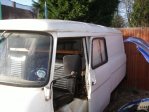
"You,re only supposed to blow the bloody SLIDING doors off"
"You,re only supposed to blow the bloody SLIDING doors off"